|
 |
 |
|||||||
 |
 |
 |
 |
 |
|||||
| Outline Curriculum Staff Research facilities History Access | |||||||||
|
|
|||||||||
|
Curriculum |
||||
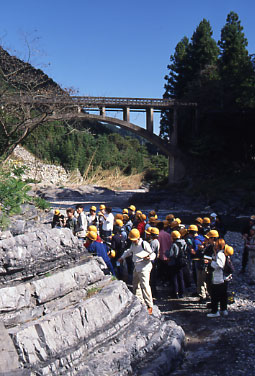
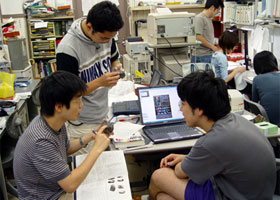
The curriculum of the Department of Earth Sciences focuses on the theories and techniques necessary to interpret unknown information recorded in the Earth. To this end, field work is emphasized alongside lectures. A graduation research project is the most important part of the four-year curriculum. In this project, each student makes full use of the knowledge accumulated through various lectures and exercises, as well as the skills and experience gained through experiments and practical training, to explore and solve unknown challenges through repeated trial and error. In the process, students develop their own unique perspectives and skills, and train their thinking to describe natural phenomena and society, thereby creating new insightts. Therefore, it is important for students to build a solid foundation by thoroughly studying specialized courses before engaging in their graduation research. To this end, we offer a variety of elective courses related to Earth sciences. Additionally, the curriculum is designed to allow students to take a wide range of courses, including those for teacher certification programs. Furthermore, foundational specialized courses are provided in the first year for students who have not studied Earth science in high school, ensuring that all students start at the same level. |
Excursion in Shimonita, Gumma Prefecture.
|
|||
|
|
||||
|
|
In graduate school, students acquire more advanced specialized knowledge as well as investigation and analytical techniques. Graduate students devote themselves to research daily and publish their results in academic journals. They also serve as valuable mentors for undergraduate students. Many graduates have gone on to advance their research as scientists and educators at universities and research institutions. |
|||
|
Copyright(c)Department of Earth
Sciences, School of Education, |
||||